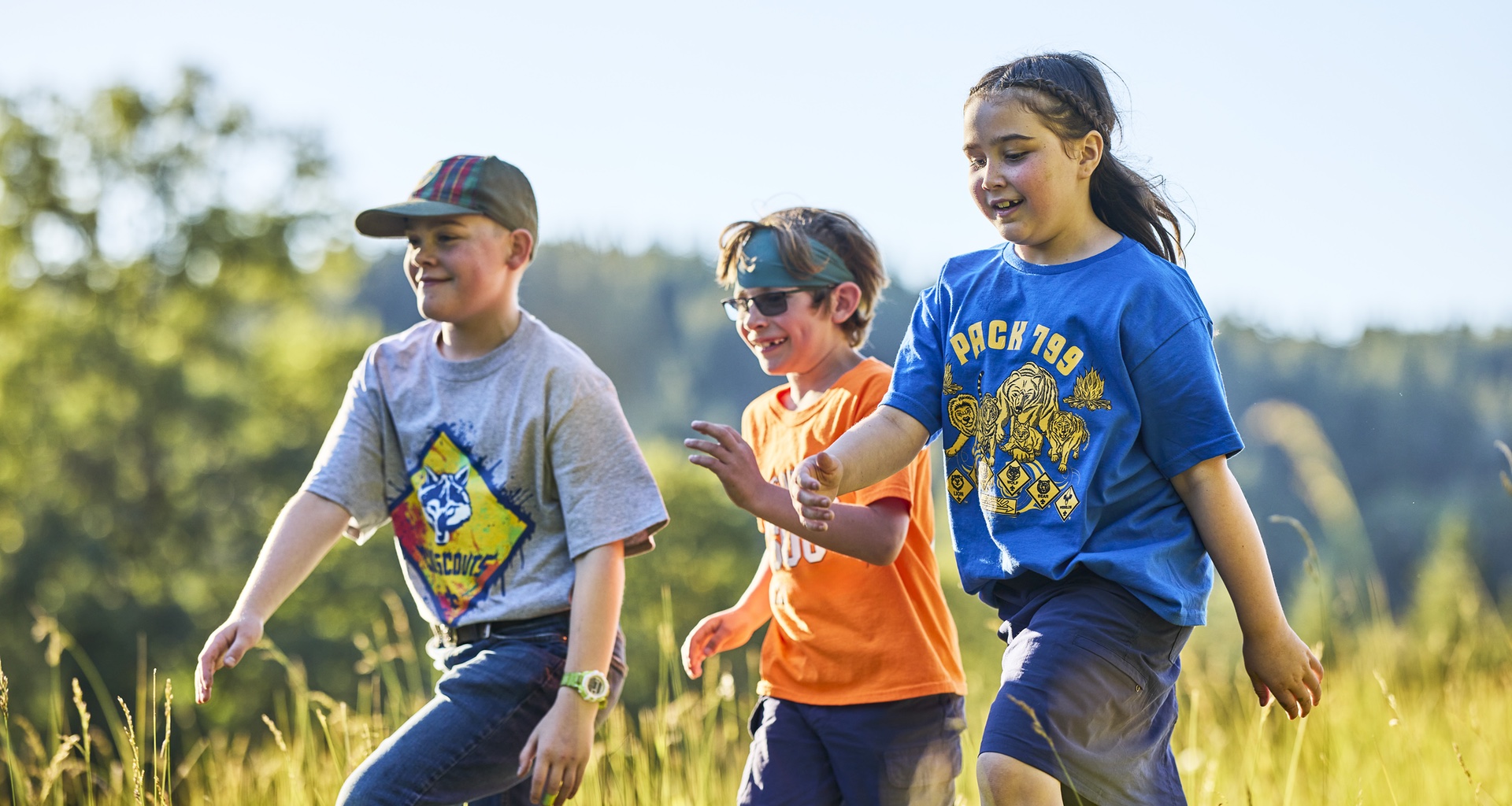
Scouting is a time-tested program that offers kids and families many benefits. For kids, Scouting is fun, builds friendships, and offers exposure to adventures they don't get from other clubs. For families, Scouting gets kids off screens and outdoors, and builds strong minds and bodies.
The materials on this site offer Cub Scout leaders clearly structured playbooks to manage their recruiting efforts in a simple, direct way. Playbooks were developed from first-hand knowledge of experienced leaders who ran large packs. Events are easy to adapt for your pack's needs.
Fun-First Recruiting
1. The Big Idea: Show, Don't Sell
Most recruiting nights have the wrong goal. They focus on maximizing parent sign-ups with a presentation, a sign-up table, an application, a payment, and hope that parents sign up their kids. Families come to find out whether their child might like Scouting and instead they get a lecture.
A better approach is to focus on Scout fun. Let kids experience the joy of Scouting and the range of hands-on adventures families can have. A child who launches a rocket, races a car down a track, and walks out holding something they made does not need to be sold on Scouting, they have already decided. They will do the selling for you on the car ride home. Support parents' decisions with the information they need to say yes: pack information, the next exciting event date, and the QR code for sign-up.
This is not wishful thinking; it is how families actually join. Families overwhelmingly join because someone personally invited them (a friend, a current Scout, a neighbor). A great experience turns a kid into a recruiter and gives a parent something easy to say yes to.
Know your audience
For Cub Scouts there are two customers in the room and they need different things:
- The child must have fun: Five-to-ten-year-olds decide with their hands and their gut. Fun is the entire argument.
- The parent must see the vision: They sign, they pay, and in Cub Scouting they show up every week. Parents are not won by hype, they are won by a warm welcome, clear logistics, and watching their kid light up. The messages for parents:
- “Scouting gets kids off screens and outdoors.”
- “Scouting teaches values like being trustworthy, friendly, courteous, and kind.”
- “Scouting builds strong minds and bodies.”
So the event has one job for each person: win the child's heart, and hand the parent an easy, low-pressure yes. These recruiting events are built around those two outcomes.
2. The Three Principles
Principle 1: Self-directed fun
Activities should be obvious and self-directed. A child should be able to immediately start doing the activity with the minimum of instructions or rules. No opening ceremony, no “speeches about Scouting.” Hands on equipment, immediate fun, and a flyer to take home.
Principle 2: Parents get a 60-second yes, not a pitch
A parent watching their kid have a blast is already three-quarters convinced. Do not talk them back out of it with a long sales pitch. Give them three answers and a way in:
- What does it cost? Have the real number, and the financial-aid answer, ready.
- How much time? Be specific and honest, for example, one den meeting and one pack activity a month.
- What's the next fun thing, and when? This is the hook, see Principle 3.
Then hand them a QR code to your BeAScout page and let the kid's face do the rest.
Principle 3: Close on the next adventure, not “sign here”
The strongest close is not “join tonight.” The strongest close is “we're launching rockets at the park on the 14th, want to join our pack?” You are selling the next dose of fun; membership is simply how a family keeps getting it. A kid already looking forward to the next event is far easier to enroll than one being asked to commit to an abstraction.
3. What This Changes
Scout fun first is different from a traditional sign-up night. It changes the goal, the name, and how you measure success.
| Traditional sign-up night | The Scout-fun way | |
|---|---|---|
| Goal: | Collect applications tonight | Spark desire and gather contacts for every family |
| Event: | “School Night to Join Scouting” | “Scout Jamboree” or “Scout Adventure Night” |
| First thing: | A welcome talk to seated families | Kids are engaged at a station within a minute |
| Parents: | Sit through a presentation | Watch their kid and chat with friendly volunteers |
| The ask: | “Sign up now” | “Come to our next adventure” |
| Success: | Applications that night | Parent emails and some sign-ups that night |
| Star of the show: | The pitch | Kids having fun |
4. Choosing Fun That Actually Works (Ages 5–10)
Cubs are short on patience and long on enthusiasm. Pick activities with these traits:
- Easy to understand: minimize the instruction needed from adults
- Limited supervision required: kids should feel free to explore without rules/constraints, except where safety dictates.
- Kids can explore as they please: no start/end times for activities
- Something to do, not watch: a line of kids watching one kid is a dead station. Aim for parallel activity.
- A take-home: a rocket, a Pinewood Derby car, or a craft. The object becomes a story and a reminder.
- A pinch of awe: flight, fire, speed, a satisfying launch. Wonder is sticky.
You do not need lots of stations. Four great ones beat ten mediocre ones. Here are kid-approved activities you can use.
5. The “Earn the Ask” Engine
A Scout fun day fails if the enthusiasm fades: if you can't follow up with families and reinforce the next event date, after a few days the energy is gone. Keep up momentum with four simple actions.
- Capture, don't close: Set one low-pressure goal for the event: get every interested family's name and contact, usually with a quick lead card or by scanning your BeAScout QR. No one has to “decide” tonight (but do help them sign up if they ask!). Use participation in an upcoming event as the requirement for sign-up, such as a campout, which requires registration.
- Send them home with something: Every kid leaves holding a thing they made or won. It is a physical reminder and a dinner-table story, “look what I made at Scouts.” That object keeps working for days after the event.
- Put the next adventure in their hands: Give every family a printed “Our Next Adventures” card with two or three dated, fun, guest-friendly events. The invitation is concrete and low-stakes: come to the next adventure.
- Follow up within 72 hours (warm, not salesy): Assign who contacts each family, by when, and with what template. The message is fun-forward: “Your son built an awesome catapult on Saturday! Our next adventure is a campfire night on the 14th, we'd love to have you. Here's the link to join the pack.” Joining should feel like the easy next step, not a leap.
6. Volunteer Roles for a Fun-First Event
- Activity Station Leaders: run the fun. One or two per station. Their only job is energy and flow. Give the shortest explanation possible (zero is best) and let the kids start having fun. Use older Scouts from troops when possible.
- Fun Ambassadors (Floaters): circulate among parents, answer the three questions, read the room. Warm and casual, never cornering. A few ice breakers to open a conversation:
- “Were you in Scouts as a child?”
- “Is your child having fun today?”
- “Have you ever been camping with your child?”
- Record Contacts: owns the contact cards and QR sign-ins. Makes sure no interested family leaves unrecorded.
- Next-Adventure & Follow-up Lead: owns the “next adventures” card and the 72-hour follow-up list. Arguably the most important role, this is where sign-ups are actually won.
- Photographer: candids of kids mid-fun (with photo permission). Fuel for social posts and for next year's flyer.
7. Did It Work? (Better Metrics)
Judge the event over the following month, not at 8 p.m. that night.
- Leads captured (interested families with contact info)
- Percent followed up within 72 hours (aim for 100%)
- Kids who asked to come back, or showed up to the next adventure
- New youth applications in the four weeks after the event
- Returning-family rate at your next one or two events