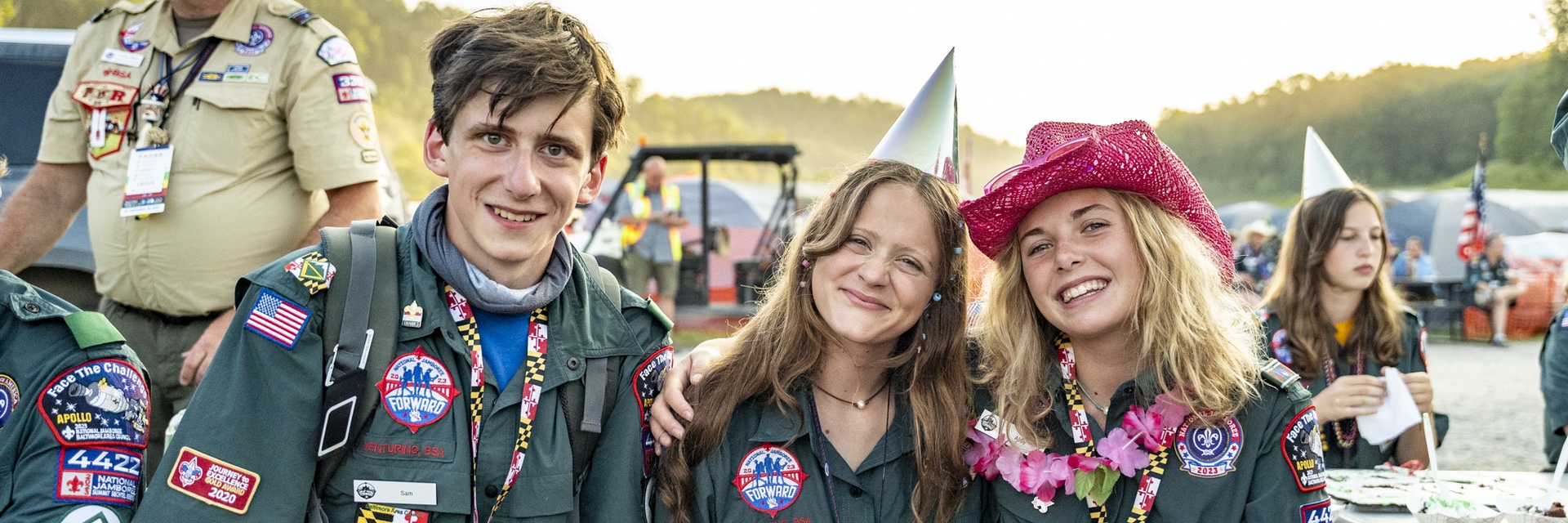
Overview
A Scout Jamboree is a community-wide recruiting event that showcases the fun of Scouting for kids. Several local Cub Scout packs collaborate to put on one big outdoor afternoon of hands-on activities. The purpose is to drive Cub Scout recruitment by showing families a great time, not by selling them on a program. Showing kids the kind of fun we have in Scouts draws far more enthusiasm and interest than an information session would.
Two jobs: fun for kids, answers for parents
The event has two components running side by side. The first is unstructured fun for Scout-age children at a set of activity stations. The second is information and registration for parents, who can ask about Scouting, camping, typical activities, schedules, and child safety. Lead with the value: Scouting gets kids off screens and outdoors, teaches character and leadership, welcomes all families, and is affordable (most activities are free, and scholarships are available for dues and any extra fees).
Promote Scouting, not one pack
The core idea is to promote Scouting community-wide and avoid promoting any individual pack. Every pack is open to any child from any school or town, so present a united front and let families find the pack that fits them.
Bring a friend
The single best recruiting mechanism is friends having fun together. Ask every current Scout to invite at least a few friends (more is better), and collect those names in advance. A child who comes with a friend, launches a rocket, and walks out holding something they made has already decided to join.
Keep it local and focused
Start local and keep the scope tight. Efforts that stretched across multiple towns and added older age groups proved to be several times the work for far fewer recruits. Focusing on Cub-age families (roughly kindergarten through fifth grade) in your own community produces better results. Measure success by new registrations in the weeks after the event, not by attendance on the day.
Registration and capture
Make signing up effortless and capture every interested family. Give a wristband to every child once a parent provides contact information or registers. Parents scan a QR code to your council or BeAScout page, where they can either leave their contact information for free or sign up and pay on the spot. Offer a small incentive, such as a Scouting t-shirt, for families who register the same day. Follow up promptly with everyone who left contact information.
Roles and self-sufficiency
A few clear roles keep the day running:
- Point people: a small team that solves problems, directs volunteers, and makes decisions.
- Registration table: staffs sign-in, wristbands, and the QR registration flow.
- Floating ambassadors: greet families, answer questions, and get people excited about Scouting.
- Parking and traffic: signs and a monitor to guide families in.
Each pack takes ownership of one or more activity stations and plans to be totally self-sufficient, bringing its own tables, chairs, supplies, and enough adult and older-Scout leadership for safe operation.
Calendar of Activities
A timeline working backward from event day. A late-summer or early-fall date works well, landing right as the school year starts. Adjust the lead times to your own schedule.
7 to 8 weeks before
- Recruit the participating packs and name a small organizing team.
- Pick the date, an outdoor location, and a rough site layout (registration, first aid, parking, and activity stations).
- Design the recruiting flyer with good photos and clear copy.
5 to 6 weeks before
- Send flyers to print, enough for every participating pack and school.
- Finalize the activity list and assign each station to a pack.
- Ask every pack to mobilize its Scouts to invite friends, and start collecting names.
3 to 4 weeks before
- Begin advertising: distribute flyers to packs, start social media, and send notices to local newspapers.
- Confirm volunteers and station assignments.
1 to 2 weeks before
- Start flyer handout at schools and through the school Digital Backpack as the school year begins.
- Do a final review of the emergency plan (heat, weather, first aid, and emergency services).
- Confirm all flyers are distributed.
- Prepare the “Our Next Adventures” follow-up cards: a printed card listing two or three dated, fun, guest-friendly upcoming events to hand to every family.
Event day
- Setup: arrive about an hour early to set up stations, signs, registration, and first aid.
- Run: open for roughly two hours of unstructured fun, with ambassadors greeting families and steering them to registration.
- Cleanup: pack out everything you brought, do a line sweep of your area, and leave no trace.
After the event
- Follow up promptly with every family who left contact information.
- Thank the volunteers and participating packs.
- Capture lessons learned for next year.
Advertising & Marketing
Awareness comes from a few channels working together. Start early, since most of the work happens in the weeks before the event.
Bring a friend
This is the most effective channel by far. Each pack asks its Scouts to bring at least a few friends, and more is encouraged. Collect the names ahead of time so you can plan and follow up.
Flyers
- Create one clear Cub Scout flyer with strong photos and simple copy. Print enough for every pack and school.
- Distribute both physically at schools and digitally through the school Digital Backpack. Confirm in advance that each school allows physical handout.
- Collate flyers into bundles of about 25 to make distribution easy for the school office.
- Get into the PTA newsletter for each school.
Social media
Run paid local ads targeted by location, and post a short, fun video of Scouts in action.
Local newspapers
Send notices to your community papers. They often run free notices and welcome a youth-group photo.
Work with your council or district
Your council or district office can often print flyers, promote the event in newsletters, and supply signage and registration links. Loop them in early.
Activities
A Jamboree works best when kids can wander between hands-on stations and start having fun within seconds. The strongest activities share three traits: they are easy to understand with little adult instruction, they need minimal supervision (except where safety requires it), and kids can come and go as they please with no fixed start or end times.
The table below collects activities that packs have run successfully at past Jamborees. Pick a handful that fit your space, volunteers, and budget. You do not need all of them: four or five well-run stations beat a dozen thin ones. For each station, plan to be self-sufficient, bringing your own tables, chairs, supplies, and volunteers.
| Activity | What kids do | Typical materials |
|---|---|---|
| Building & making | ||
| Hammer skills | Drive nails into a wood beam at their own pace. | Soft wood beams (4x4 or doubled 2x4), short nails, light hammers, sawhorse supports, eye protection. |
| Build-it kits | Assemble a simple pre-cut wood project (toolbox, birdhouse, car) to take home. | Pre-cut wood kits, glue or nails, hammers. A local hardware store will often donate kits or run the station. |
| Bracelet & craft making | Make a paracord or bead bracelet to wear home. | Paracord or beads and string, scissors, tables, chairs. |
| Pinewood Derby | Race demonstration cars down the classic track. | Pinewood Derby track, sample cars, start gate. |
| Push / soapbox cars | Push or coast small cars along a flat sidewalk or ramp. | A few sturdy push or ride-on cars, a flat paved stretch. |
| Raingutter Regatta | Blow or fan toy boats down water-filled gutters. | Raingutter or trough, water, toy sailboats. |
| First aid kit making | Assemble a small personal first aid kit to keep. | Small boxes or tins, stickers, bandages and basic supplies, table, canopy. |
| Gumdrop towers | Build the tallest structure from candy and pasta. | Spaghetti, gumdrops or marshmallows, tape, string, tables. |
| Rockets & launchers | ||
| Air / stomp rockets | Launch paper rockets with a foot pump or air launcher. | Paper, tape, an air or stomp launcher, bike pump. Timed group launches draw a crowd. |
| Water rockets | Pressurize and launch 2-liter bottle rockets. | 2-liter bottles, a water-rocket launcher, water, a pump, an open landing area. |
| Giant slingshot | Fire soft projectiles at a target. | Three-person slingshot rig ($24 on Amazon), 16 oz bean bags, a baseball backstop or roped-off safety zone. |
| Trebuchet | Launch soft projectiles with a small siege machine. | Trebuchet, 16 oz bean bags, a target, a fence or baseball backstop. |
| Large rocket display | See large model rockets up close (4' to 10' rockets). | Large model rockets, a table or rocket stand. |
| Outdoor & Scout skills | ||
| Tent city | Walk through and climb into a variety of tents. | An assortment of tents (large, tiny, backpacking, family), ground tarps. |
| Canoe / paddling setup | Sit in a canoe or kayak on land and try paddles and life jackets. | Canoe or kayak, paddles, life jackets (PFDs). |
| Fire-building demo (no flame) | Learn fire lays and try a flint and steel spark. | Tinder, kindling, logs, flint and steel. No open flame needed. |
| Rope bridge | Cross a low pioneering rope bridge. | Rope bridge (monkey bridge) rigging, anchors, trained adults. |
| Knots & lashings | Try basic Scout knots and lash poles together. | Rope, poles, a knot reference board. |
| Compass & wayfinding | Follow a short compass course. | Compasses, simple course markers. |
| Geocaching | Use GPS or clues to find hidden caches. | GPS units or phones, hidden caches, clue cards. |
| Log splitting (supervised) | Use a hammer and fixed wedge (a wedge welded to the bottom of a splitting frame; a hammer NOT an axe!) to split kindling. | Cordwood, a 4 lb hammer, a safe splitting frame or kindling cracker, adult supervision. |
| Magnetic fishing | "Catch" fish with a magnet rod. | Printed fish with magnets or clips, magnet rods, a blue tarp pond, a fish ID guide. |
| Games & teamwork | ||
| Tug of war | Classic team pull: Scouts vs. Scouts and Scouts vs. adults. | A heavy rope, a center marker, open grass. |
| Tarp flip | A team stands on a tarp and flips it without stepping off. More kids add to the challenge. | A medium-sized tarp (6' x 4'). |
| Team ski race | Three or more kids walk together on 2x4s. | Two 6- to 8-foot 2x4 boards with rope handles. |
| First aid relay | Teams race through simple first aid tasks. | Bandages, slings, stations, simple scenario cards. |
| Field games | Run classic running and tag games (Steal the Bacon and similar). | Balls, field cones, a marked field. |
| Inclusion / adaptive games | Throw-and-catch games that build disability awareness. Catch with your non-dominant hand, blindfold one eye. | Balls, blindfolds. |
| Community & demonstrations | ||
| Fire truck / first responder visit | Explore a fire truck or meet local first responders. | Coordinate in advance with your local fire or police department. |
| Climbing wall | Climb a portable climbing wall. | Portable wall and a certified operator, commonly available from your council. |
| Civic guest | A mayor or local official greets families. | Invite a local official well in advance. |