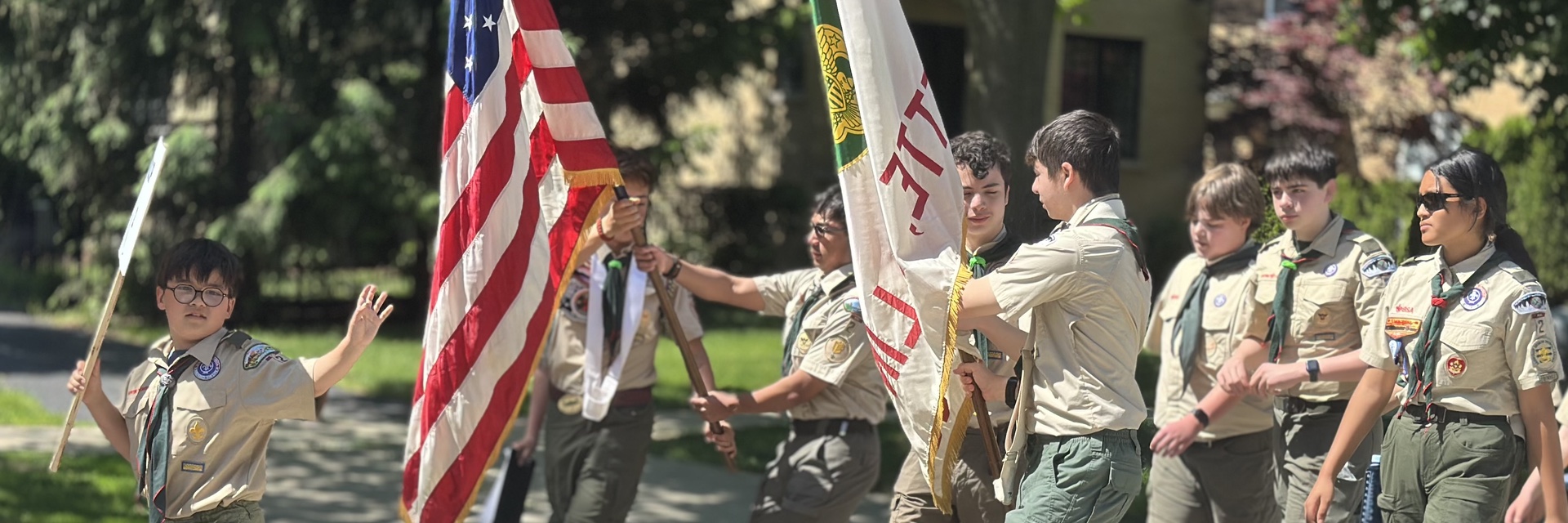
Overview
Marching in a hometown parade is a great high-visibility activity for Cub Scouts to do. It teaches the kids citizenship and pride, lets families participate together, and builds strong community awareness for your pack. Crowds love seeing a line of smiling Cubs in uniform, and it puts your pack in front of every family in town.
Who runs the parade
Community parades (Memorial Day, Independence Day, Labor Day) are almost always organized by a local parade committee, the town or city recreation department, a veterans' organization (common for Memorial Day), or a chamber of commerce.
The sign-up process
The core process is the same almost everywhere:
- Find the organizer. Search for your town's parade or check the town or city website, the local paper, and community Facebook groups. Look for a "Parade Entry Form," "Participant Registration," or a "Get Involved / Participate" page.
- Read the rules first. Most committees post Parade Rules and Regulations separately from the entry form. Read them before applying. They cover line-up time, the route, and what you may or may not hand out.
- Submit the entry form. This is usually a short online form (often hosted on the town site, a committee website, or SignUpGenius). You will typically provide your organization name (for example, "Cub Scout Pack ###"), a contact person and phone or email, your entry type (walking or marching unit versus float), and an estimated number of participants. Consider if you want to invite other local packs to march with you.
- Watch the deadline. Registration windows commonly open about a month out and close one to three weeks before the parade. Do not wait, because popular parades fill or cut off entries.
- Confirm details a week in advance. After you are accepted, the committee sends the line-up location, your assigned staging spot or number, step-off time, and the route map. Some assign all youth and Scout groups to march together.
- Communicate to your pack. Share the information with your parents and set any expectations for clean uniforms.
Cost and eligibility
Youth Scout groups are explicitly welcomed at nearly every community parade, and entry is usually free for non-profit and local civic groups (businesses sometimes pay or must sponsor). Confirm on the entry form.
Calendar of Activities
A timeline working backward from parade day. Adjust the lead times to your parade's actual registration window.
8 weeks out
- Identify the parade organizer and locate the entry form and rules.
- Put the event on the pack calendar and get Cubmaster or committee approval.
- A simple marching unit (flags and banner) is recommended. A float or decorated entry means more planning, effort, and rules.
6 weeks out
- Submit the parade entry or application form.
- File any council-required activity plan and arrange adult leadership (aim for a healthy adult-to-Cub ratio plus extra "edge walkers").
- Send a save-the-date to all pack families. Walking in a parade is a highlight for Cubs.
4 weeks out
- Open family RSVPs (Scoutbook, a Google Form, or SignUpGenius) so you know your headcount.
- Confirm the theme and what each Scout carries or wears.
- Begin advertising to the community and using it as a recruiting push (pack website, Facebook/Instagram, PTA newsletter).
2 weeks out
- Send the logistics packet to families: line-up time and location, step-off time, route map, parking, where to meet before and after, uniform expectations, what to bring (water, sunscreen, closed-toe shoes), and an emergency cell number.
- Confirm the pack flag, American flag, and pack banner are clean and ready.
- Prepare the “Our Next Adventures” follow-up cards: a printed card listing two or three dated, fun, guest-friendly upcoming events to hand to interested families.
Parade week
- Hold or schedule a brief pre-parade leaders' meeting.
- Confirm the final parade instructions (staging spot or number).
- Check the weather forecast and prep a heat and rain plan.
Parade day
- Arrive early to your staging spot with buddy-system check-in.
- Do a uniform review and pass out extra neckerchiefs for anyone who forgot theirs.
- Give the Cubs the "marching is a privilege, we represent all of Scouting" talk.
- March, smile, and wave!
- Regroup at the agreed after-meeting spot and celebrate the event.
After the parade
- Thank the committee and your volunteers.
- Post photos and a follow-up "join us" message (see Advertising & Marketing).
- Capture lessons learned for next year.
Advertising & Marketing
Advertising works on two fronts: inside the pack (to get turnout) and outward to the community (to recruit and build goodwill).
Promoting within the pack
- Announce at pack and den meetings and in your normal channels (Scoutbook, email, pack app, private Facebook group, GroupMe or Band).
- Send the save-the-date early and the detailed logistics packet about two weeks out.
- Frame it as a fun, low-cost, whole-family event: siblings and parents can often walk too.
- Use a simple RSVP link so leaders can plan ratios and supplies.
Promoting to the community (and recruiting)
A parade is a prime recruiting moment, so capitalize on it:
- Hand out recruiting flyers along the route. A common, effective approach is a small quarter-page flyer with your pack name, a QR code or short URL to join, a contact email, and your next "join night" date. Your council or district office can often print these for you, so ask. (Check the parade rules first: many parades prohibit throwing candy or items, and some require any handout to be pre-approved. When in doubt, walkers hand flyers directly to interested families rather than tossing anything.)
- Make the pack name readable. Use a clear pack banner ("Cub Scout Pack ###, [Town]") so spectators know exactly who to look up.
- Post before and after. Announce on town and community Facebook groups and local boards that the pack will be marching ("find us and give us a wave!"), then post photos afterward with a clear "Join Cub Scouts, here is how" call to action and a link.
- Tell the local paper. Community papers often run free notices and love a youth-group photo.
- Coordinate with your council or district. They may promote the entry in district newsletters and can supply join-night dates and signage.
Activities
What the pack actually does, in the parade itself and in the supporting activities around it.
Supporting and lead-up activities
Great den or pack-meeting tie-ins:
- Decoration-making session: Cubs build the banner, signs, and decorations. This ties directly into Citizenship and community-service adventure requirements.
- Flag etiquette mini-lesson: how to carry, hold, and respect the flag, and who carries which flag.
- Practice marching: a quick run-through of staying in formation, the buddy system, and keeping the line moving.
- Service tie-in: pair the parade with a service project (for example, a Memorial Day cemetery flag placement or a food drive) to deepen the citizenship lesson.
Uniform and what to wear
- Field uniform ("Class A") is the standard and the best look for a parade: the official Cub Scout uniform for the Scout's rank, worn neatly.
- Activity uniform ("Class B"), a pack or Scouting t-shirt, is an acceptable hot-weather alternative if your pack chooses, but Class A reads best to the crowd.
- Dress for the day: closed-toe, broken-in shoes, sunscreen and hats for hot pavement, and water for everyone.
In the parade
- Marching unit (simplest, recommended for first-timers): Cubs march in two lines behind the American flag and the pack flag or banner, in uniform, waving to the crowd. Clean and dignified, and very little can go wrong.
- Decorated entry: add patriotic decorations the Cubs help make (red, white, and blue streamers, hand-made signs, decorated wagons or bikes where the parade allows).
- Color guard / flag presentation: especially fitting for Memorial Day, which honors those who died in military service. Emphasize the solemn, respectful tone with the Scouts beforehand.
Key rules and safety
- Buddy system the whole time, since routes can be crowded.
- Organize hydration and sun/bug protection: Remind parents to apply products through the day and set a timer on your phone to remind people for hydration breaks.
- Fitness and skill level: make sure young Cubs (and older adults) can handle the route length. Hot asphalt and distance are real factors for little legs, so have a plan for anyone who tires.
- Weather: if you hear thunder, seek safe shelter immediately, and have a heat plan with water and shade.
- Planning: clear before and after meeting spots, route maps, and an emergency cell number distributed to all families. Brief the adult leaders beforehand.
- Discipline and tone: remind the Cubs that marching is a privilege and they represent all of Scouting.
- Handouts: do not throw candy or items unless the parade explicitly allows it. If passing out candy, hand out sign-up information with it.
- Floats and trailers: floats are not recommended because they add complexity but don't increase the fun. Scouting America generally prohibits riding in the back of trucks or on trailers, with a narrow exception for parade floats only if the specific safety points in the Guide to Safe Scouting's "Parade Floats and Hayrides" section are followed strictly. Read them before committing to a float.
Sources and useful links
- Scouting America, Parade Safety (one-page guide): filestore.scouting.org/filestore/pdf/paradesafety.pdf
- Bryan on Scouting, parade safety tips: blog.scoutingmagazine.org/2014/12/04/holiday-parade-safety