Overview
The Pinewood Derby is a classic Scouting event. Generations of Cub Scouts have designed, built, painted, and raced cars. Adults usually remember the excitement from their childhood Pinewood Derby. Many packs already hold a Pinewood Derby every year, but it also makes an outstanding recruiting event in the winter for new families.
Why it works for recruiting
A Derby is "show, don't sell" in action. Invite prospective families to come watch, and the event sells itself: the gym is loud, every kid is cheering, and a visiting child sees other kids racing cars they built. Siblings and guests are welcome to build and race their own cars (require registration in Scouting in order to win trophies), so a prospective family can go from spectator to registered Scout in the same afternoon. Pair the Derby with a follow-up invitation and it becomes a recruiting moment, as well as a pack tradition.
The two-part structure
A successful Derby is really two events, and most of the work is in the first one:
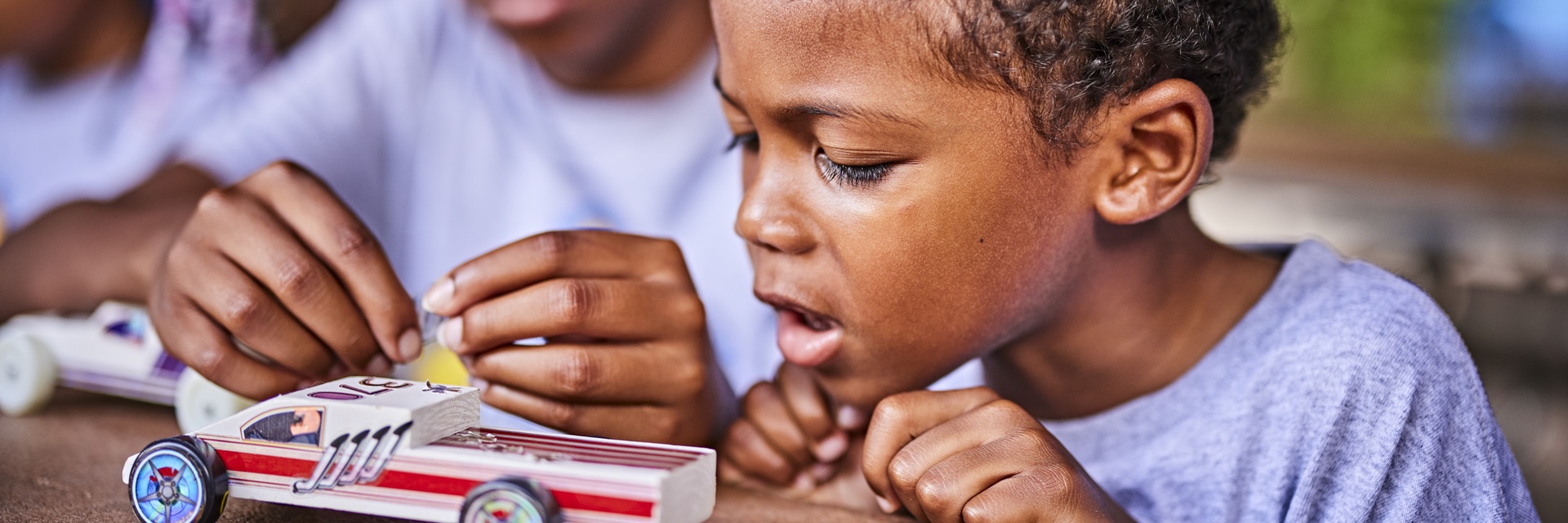
- Build workshops (two or three weekends before race day): families pick up a kit and design, cut, sand, paint, weight, and tune their cars at shared work stations. The workshops are where the real Scouting skill-building happens. It is also a great opportunity to discuss joining the pack.
- Race day: cars are checked in against the rules, raced in heats by den, and celebrated with awards. Plan for a brisk, well-staffed afternoon. You may also have cars from prior years that visiting kids can choose from to race on race day.
Who runs it
There are many excellent guides to running a Pinewood Derby. Those guides cover the race mechanics well; this playbook layers in the marketing and outreach to new families. If you're new to running a Pinewood Derby, form a small committee early and divide ownership. The roles that past packs found essential:
- Event lead: owns the schedule, books the space, and books a race official to run the track and timing software.
- Workshop lead: owns kits, materials, and tools, plus the workshop space and its volunteers.
- Race-day lead: owns the run-of-show, volunteer sign-ups, check-in, and awards.
- Track and electronics crew: a few detail-oriented people to assemble the track (level, same-length sections, screws tightened evenly) plus one or two to run the timer, cables, and computer.
Calendar of Activities
This covers the long lead-up planning timeline and the run-of-show for race day itself. Adjust the day counts to your own calendar.
4 months out
- Set the race date in coordination with your race official and your venue so it works for both.
- Book the race runner / official who owns the track and timing software. Aim for a setup that can run two races per minute.
- Book the race space (a school gym works well; many councils also offer their space for Derby races).
- Schedule the build workshops with your pack committee, working backward from race day. Allow two to three weekends before the race for Scouts to build their cars.
2 months out
- Book the workshop or garage space. A community workshop or makerspace is a good option because of the bandsaw and ventilation for painting.
- Recruit your workshop and race-day volunteer crews (see the volunteer roles below).
- Take inventory and purchase workshop materials (see the materials lists under Activities).
- Buy car kits: one per Scout plus several extras for mistakes, siblings, and guests.
- Buy trophies, medals, and patches (allow lead time for custom patches/awards).
- Update your BeAScout.org listing (meeting day, location, contact) so families who look you up after hearing about the race find the right information.
- Design the "come watch the races" flyer for prospective families: date, time, location, a good photo, and a note that siblings and guests can race too. Ask your council or district for help printing flyers and yard signs.
3 weeks out
- Confirm a scale is available at every build event so cars can be weighed as they are finished.
- Hold the build workshops (design, cut, sand, paint, add weight, mount and tune wheels, weigh in).
- Set up, run, and clean up each workshop with signs, tarps, drop cloths, and snacks.
- Submit the flyer to school channels: the school "digital backpack" (electronic flyer system), PTA newsletters, and school newsletters. Their publishing lead times are often two weeks or more, so submit now.
- Post the invitation in community Facebook groups, and consider a small paid local Facebook or Instagram ad targeted by location, with photos from a past race.
- Ask every Scout to personally invite a friend to come watch and race. A personal invitation from a friend out-recruits every other channel.
2 weeks out
- Design and print the voting ballots (recommended categories: Coolest, Most Creative, Funniest) or set up a QR-code voting form.
- Open an Evite or SignUpGenius for race-day volunteer slots and any potluck snacks.
- Prepare the “Our Next Adventures” follow-up cards: a printed card listing two or three dated, fun, guest-friendly upcoming events to hand to every prospective family.
- Place yard signs where families will see them, especially school pickup and drop-off lines.
- Print the BeAScout QR code (large, on a stand or poster) for the guest welcome table, plus simple lead cards for families who prefer pen and paper.
1 week out
- Send the race roster (each Scout's name and den) to the race official, and plan to update it on race day for additions, siblings, and guests.
- Finalize and circulate the race-day agenda.
- Send a reminder through the school and Facebook channels, and a personal note to every prospective family who has expressed interest.
- Optional but recommended: hold car check-in at a pack meeting the week before so heats can be set in advance and race day runs tighter. Collect the reviewed cars and hold them until race day to reduce the start-up time.
Race day
A clean, brisk schedule keeps young kids engaged. For very large packs, consider starting older Scouts first, then have younger Scouts join to maximize their attention spans. Aim for two heats per minute to keep race action high.
| Time | Activity |
|---|---|
| 11:00 am | Volunteer setup: track, check-in, fix-it station, guest welcome table, tables, decorations. |
| 11:45 am | Guest welcome table opens: greet visiting families, capture contact info (BeAScout QR code or a lead card), and hand each family an “Our Next Adventures” card. Visiting kids pick a loaner car to race. |
| 12:00 pm | Arrival and check-in for older dens (Arrow of Light, Webelos, Bears). |
| 12:15 pm | Arrival and check-in for younger dens (Wolves, Tigers, Lions). |
| 12:30 pm | Audience-choice voting (Coolest, Most Creative, Funniest) opens once all cars are checked in. |
| 12:45 pm | Opening ceremony (welcome the visiting families by name of school or neighborhood, a cheer, explain voting and good sportsmanship), and begin races. |
| During racing | Floating ambassadors chat with visiting parents: answer the cost and time questions, point to the BeAScout QR code, and make sure no interested family leaves uncaptured. |
| After racing | Awards and group photos. Confirm every visiting family has the “Our Next Adventures” card before they head out. |
| After awards | Volunteer cleanup and takedown. |
Hold voting after every car is checked in, and tally votes during the racing so winners are ready by the awards. Aim for less than two hours of racing even for a large pack to keep the energy up.
After the event
- Notify the venue custodian when cleanup is done (a small courtesy that keeps your space relationship healthy).
- Post photos and a follow-up "join us" message for any prospective families who attended (see Advertising & Marketing).
- Capture lessons learned while they are fresh (see the tips below).
Advertising & Marketing
Derby promotion works on two fronts: inside the pack (so families build cars and show up to race) and outward to the community (so prospective families come watch and get invited to join).
One "start your engines" email to families
Send families a single, do-it-all message that serves as the one-stop shop for the Derby. Include:
- The build workshops: what happens (pick up kit, design, cut, paint, then later wheels, weights, and weigh-in), plus dates, locations, and what to wear (Class B shirts with a smock or grunge clothes for painting).
- The race: date, time, location, and the award categories (fastest, coolest, funniest, most creative).
- The race-day schedule so families know their den's check-in and race times.
- A volunteer call: name the crews you need (pit crew, start and finish line, setup and takedown, concessions) and note that no experience is required.
- The fine print: your pack's car rules and specifications, so there are no surprises at check-in.
Reaching prospective families (recruiting)
- Make the race an open house. Invite prospective families to come watch, and tell them siblings and guests can build and race a car too. A loud, joyful gym full of kids is the best advertisement Scouting has.
- Use your normal recruiting channels: the school "digital backpack," PTA newsletters, community Facebook groups, and word of mouth from current families. Ask each Scout to invite a friend.
- Capture and follow up. Collect contact info from interested families at the guest welcome table (the BeAScout QR code or a quick lead card) and follow up within a couple of days with a warm note and a specific invitation to your next meeting or event.
- Photograph everything. Candids of kids mid-race (with photo permission) fuel social posts and next year's flyer. A short "join Cub Scouts, here is how" post with a link and a few photos converts after the fact.
Voting and engagement on the day
Audience-choice voting keeps spectators (including visiting families) involved. Print ballots, or post a QR code around the gym that opens an online voting form. Give every Scout and their guests a vote, and use ranked choice (ask for a second choice) so ties are easy to break.
Activities
The Derby has two activity phases: the build workshops (where the Scouting skills happen) and race day (where the cars compete). Below are the stations to run, the materials to gather, and hard-won tips from past races.
Build workshop stations
Set up the workshop as a flow of stations so families move from raw kit to race-ready car. Staff each station with at least one or two volunteers, and stagger arrival times so the cutting station does not back up.
| Station | What kids do | Typical materials |
|---|---|---|
| Design | Sketch a car shape on paper before cutting. | Paper, pencils, rulers, design idea books. |
| Cutting (adult-run) | Hand off a marked block; an adult cuts the shape on the bandsaw. | Bandsaw, safety glasses, an experienced adult operator. This is the one station kids do not run. |
| Shaping & sanding | Smooth the cut car with rasps and sandpaper. | Rasps, sanding blocks, sandpaper in several grits. |
| Painting | Prime, paint, and decorate the car. | Acrylic and spray paint, brushes, water cups, drop cloths, tarps, ventilation. |
| Wheels & axles | Mount wheels, drill straight pilot holes with the jig, and free up the axles. | Axle jig, drill and bits, hammer, super glue, graphite, extra wheels and axles. |
| Weight & weigh-in | Add weight to approach (but not exceed) 5 ounces, then weigh the car. | Kitchen scale, stick-on or press-in weights, a dimension checker. |
An optional axle-polishing station is worth adding: smoother axles are a meaningful, hands-on way for kids to make their cars faster. Bring a longer section of track to the workshop so cars can be test-run and any that do not reach the bottom can be fixed early. A car that stalls on race day is a real disappointment.
Race-day stations and volunteer crews
Race day for a 50-plus car pack needs a deep volunteer bench. Break the work into small, clearly defined crews so no one is overloaded:
- Setup crew: assemble the track, check-in station, fix-it station, tables, and decorations.
- Check-in crew: confirm each car meets your pack's published rules, assign a number, mark it on the roster, and place it on deck.
- Guest welcome crew: one or two friendly greeters who welcome visiting families, capture contact info (BeAScout QR code or a lead card), hand out the “Our Next Adventures” cards, and help visiting kids pick a loaner car to race.
- Pit / repair crew: make on-the-spot repairs and adjustments so every car can finish its races.
- Starting line crew: get the right cars to the track for each heat, on time.
- Finish line crew: shuttle cars from the finish back to their pre-race parking spot. A path beside the track for these runners keeps things fast and avoids collisions. Older Scouts make great runners.
- Concessions crew: set up, run, and break down snacks for Scouts and families.
- Voting crew: distribute ballots (or post the QR code), then gather and count votes.
- Breakdown crew: tear down the track, fold and store tables, and clean up.
Awards
Recognize speed and creativity so many cars have a chance to win something:
- Participation: a patch for every Scout, plus a first-Derby patch for visitors who might join Scouts.
- Audience choice: Coolest Car, Most Creative Car, and Funniest Car trophies, decided by the vote.
- Speed by den: 1st, 2nd, and 3rd place ribbons or medals within each den.
- Speed overall: 1st, 2nd, and 3rd place trophies for the whole pack.
Materials checklist
Two kits of gear, one for the workshops and one for race day. Keep the reusable Derby items (track-adjacent tools, decorations, jigs, scale) in a labeled pack bin year to year.
| Phase | Item | Notes |
|---|---|---|
| Workshops | ||
| Car kits | One per Scout plus extras for mistakes, siblings, and guests. | Scout Shop. |
| Art supplies | Acrylic and spray paint, brushes, paper, pencils, rulers, water cups. | Craft and hardware stores. |
| Sanding & glue | Sandpaper in several grits, sanding blocks, rasps, super glue. | Hardware store. |
| Derby tools | Axle jig, dimension checker, axle puller, wheel sander, extra wheels, scale, weights. | Pack Derby bin. |
| Power tools | Bandsaw, drill and bits, hammers, safety glasses. | Borrowed or pack-owned; adults only on the bandsaw. |
| Site supplies | Folding tables, drop cloths, tarps, signs, first aid kit, snacks and drinks. | Families or quartermaster. |
| Race day | ||
| Fix-it station | Derby tools, extra wheels, hammer, super glue, graphite, pliers. | For repairs and last-minute weight or size fixes. |
| Scale | One kitchen scale for weighing cars at check-in. | Pack Derby bin. |
| Decorations | Cones, caution tape, checkered flags and tape, a checkered photo backdrop, an optional floor "road." | Pack Derby bin. |
| Awards | Trophies, ribbons or medals, participation patches. | Scout Shop and award vendors; allow engraving time. |
| Voting | Printed ballots (two or three per Scout) and pens, or a posted QR code to an online form. | Anyone can design and print these. |
| Food & service | Snacks, beverages, plates, cups, napkins, utensils (potluck via the sign-up). | Families. |
| Livestream (optional) | Laptop or tablet with webcam plus a web-conferencing link for remote family. | Needs reliable venue Wi-Fi. |
Tips from past races
Lessons packs have learned through experience:
- Keep food simple: Snacks instead of a full meal reduce cleanup and work fine.
- Check cars in advance: At a pack meeting where possible, so heats are set in advance and race day flows without confusion or missed cars.
- Test on real track at the workshop: Bring a track section so slow or rubbing cars get caught and fixed early.
- Add an axle-polishing station: Print a sheet of speed tips for families.
- Use older Scouts as runners: Have older Scouts help move cars with a clear path beside the track. They enjoy the responsibility.
- Photograph each Scout with their car at check-in: The MC can hold quick trackside interviews. Kids love it and it makes great content. "What makes your car so fast?"
- A portable speaker and a charged mic: Save your MC's voice for a long program. Keep spare batteries on hand.
- Optional fundraiser: a small buy-in open category for parents, guests, and leaders (or a 50/50 raffle) adds fun and raises a little money.